Jump to a section
Calculate the number of extra subscribers you need
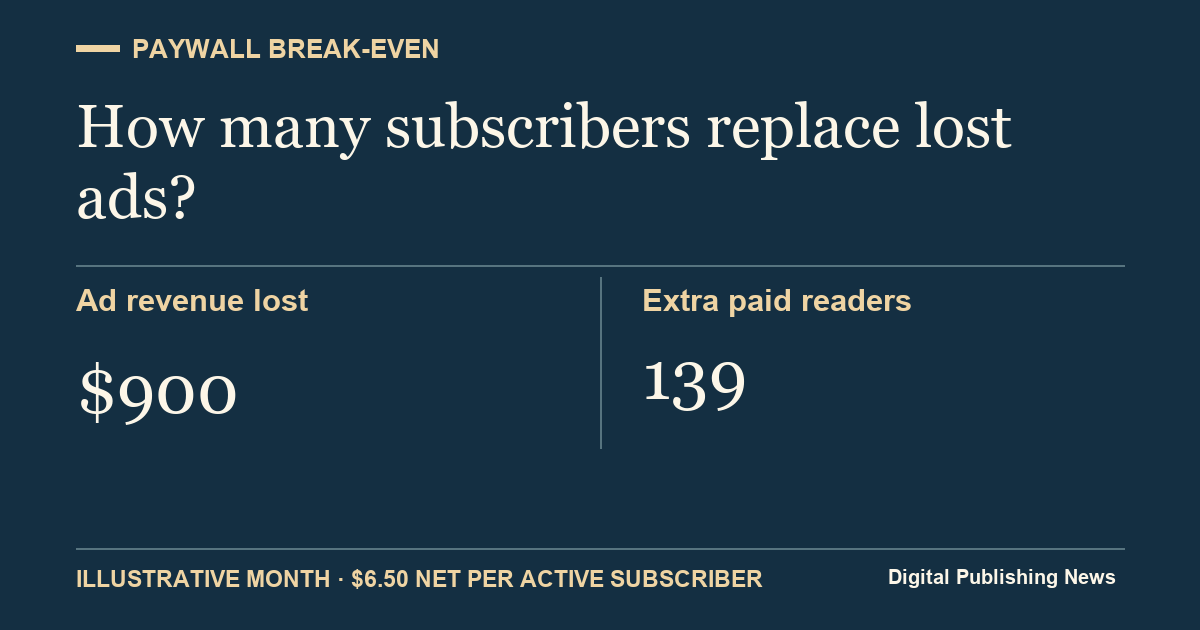
A tighter paywall breaks even on advertising when the extra subscription contribution covers the ad revenue it costs. If a stricter meter costs $900 per month and a new paid reader contributes $6.50 per month after fees and variable costs, the publisher needs 139 additional active paid readers at that monthly contribution. At 138, the new subscribers contribute $897. The last subscriber takes it over the line.
Use monthly figures on both sides. The subscription amount is the share of each payment you retain after payment or platform fees, refunds and costs that rise with each subscriber. If a reader pays annually, spread the retained amount across the months covered. A $78 net annual payment contributes $6.50 per month for this comparison, even though the cash arrives up front. Add any new recurring operating costs to the amount you need to cover.
Estimate the ad revenue exposed to the stricter rule
Google News Initiative’s ad revenue guide separates the volume of advertising you can sell from the price buyers pay for it. Use the same principle here. Find the pages whose ad exposure changes, then use their net revenue per thousand pageviews, usually called page RPM. For a section with mixed advertising, calculate that rate from total net ad revenue divided by pageviews, multiplied by 1,000. (Google News Initiative ad revenue guide ↗)
Suppose two sections each lose 100,000 pageviews after a meter change. One section earns $10 per thousand pageviews, the other earns $2. The modeled losses are $1,000 and $200, even though the same number of pageviews went away. A sitewide average of $6 would assign both sections a $600 loss and could lead the editor to put the wrong section behind the wall.
Count ad revenue on the article pages that still load for subscribers where appropriate. Some publishers show ads after a reader subscribes. If the new paid experience removes those ads, count that loss too. For sponsorships sold at a fixed fee, include only the dollars genuinely at risk, such as a lost renewal or a shortfall that requires replacement inventory.
Compare the same readers over the same window
The Google News Initiative playbook recommends testing changes to a meter, including whether the change reduces ad impressions on free visits and increases paid starts. A meter counts free reads before showing a subscription prompt. Compare readers randomly assigned to the old rule with readers assigned to the tighter rule, when your system can keep assignments stable. Divide net ad revenue and paid contribution by the number of assigned readers before comparing unequal groups. (Google News Initiative reader revenue playbook ↗)
The comparison is about new paying readers attributable to the change. If the old version produces 100 net additions and the new version produces 170 in equally sized groups, the difference is 70. Using all 170 would give the new rule credit for readers who would have subscribed anyway. Count refunds and cancellations through the same cutoff in both groups and check the first renewal when the introductory offer ends.
| Net per active subscriber | Extra active subscribers needed | Contribution at that count |
|---|---|---|
| $4.00 | 225 | $900.00 |
| $6.50 | 139 | $903.50 |
| $9.00 | 100 | $900.00 |
What one large newspaper’s test can tell you
A 2020 study by Sinan Aral and Paramveer S. Dhillon examined changes to the New York Times paywall using 2013 activity. The researchers estimated that article consumption fell about 9.9% under the changes they studied. Their subscription revenue estimate exceeded their estimated ad loss. The ad estimate depended on assumptions about ad placements and prices, and the research concerns one newspaper with a large subscription business. (Aral and Dhillon’s New York Times paywall study ↗)
The Times case shows that a decrease in reading can coexist with improved revenue when enough additional subscribers pay. On a small U.S. publisher’s site, the opposite combination is possible. For example, if the new wall produces 70 extra active readers at $6.50, their $455 contribution covers about half of a $900 ad loss. The net change on those measures is −$445 per month. Before extending the change to more sections, separate the extra subscriptions that continue at renewal from one-time purchases and examine whether the same kinds of readers are still finding the site.
Run the same calculation with your net ad revenue and subscription figures. Paywall break-even calculator for publishers
Share this article
Editorial notes & history
Primary sources checked Nov 14, 2026. Worked figures are illustrative. Published results are attributed to their source.