Jump to a section
- Judge the discount after the renewal bill arrives
- Chart or diagram
- A conversion winner can lose at renewal
- Offer A needs 76 first renewals to match Offer B in this example
- Choose the outcome before changing your introductory price
- What if refunds change the winning offer?
- Calculate the offer result per reader who could accept it
Judge the discount after the renewal bill arrives
A subscription discount can produce more initial purchases while bringing in less money. Compare the first payment and the first renewal for groups that had the same opportunity to see the offer and enough time to renew.
Ghost, a publishing and membership platform, supports offers such as introductory discounts and free trials. Its settings determine the discount’s duration and eligibility. Those settings describe the offer; they cannot tell you whether the extra subscribers compensate for the lower initial price. (Ghost offers documentation ↗)

A conversion winner can lose at renewal
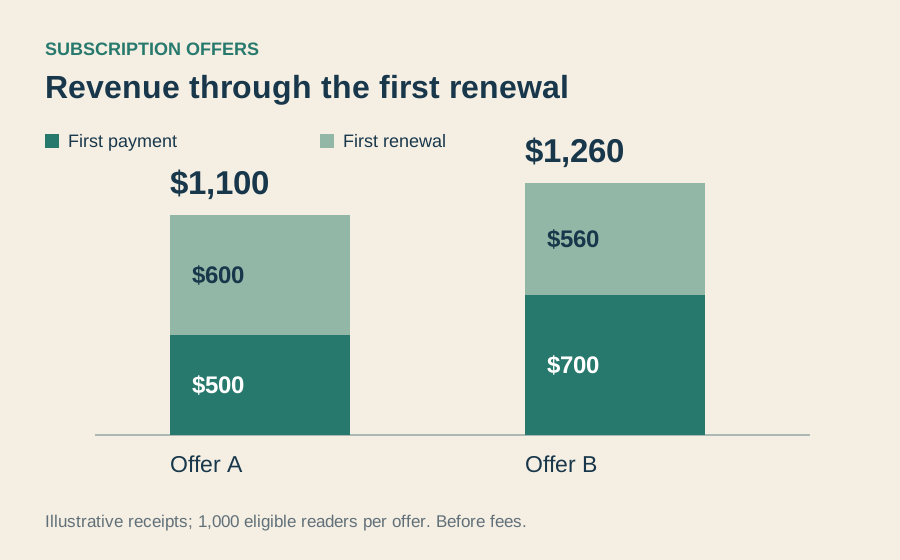
Illustration: show each offer to 1,000 eligible readers. A converts 100 at an introductory $5; B converts 70 at $10. A wins on starts, 10% versus 7%, but collects $500 versus $700 initially.
Assume these are monthly subscriptions and both renew at $10 after the first month. Give everyone enough follow-up to reach that bill. If A collects 60 renewals and B collects 56, cumulative receipts become $1,100 and $1,260, before fees and refunds. That is $1.10 versus $1.26 per eligible reader shown the offer.
| Measure | Offer A | Offer B |
|---|---|---|
| Eligible readers | 1,000 | 1,000 |
| Paid starts | 100 | 70 |
| First payment | $5 | $10 |
| Initial receipts | $500 | $700 |
| First-renewal payers | 60 | 56 |
| Renewal receipts at $10 | $600 | $560 |
| Cumulative receipts | $1,100 | $1,260 |
Offer A needs 76 first renewals to match Offer B in this example
To match B’s $1,260, A needs $760 beyond its initial $500: $760 ÷ $10 = 76 first renewals. That is 76% of A’s 100 starts. B collected from 56 of 70 starts, or 80%. Renewal counts and retention rates answer different questions because the offers created different numbers of subscribers.
Record how many eligible people saw each offer, how many paid, and how many reached and completed the first renewal. Count refunds and payment fees consistently. A more expensive acquisition offer might still pay off later, but that requires evidence from later renewals rather than an assumption that every new subscriber has the same lifetime value.
Choose the outcome before changing your introductory price
Write down whether the test is trying to maximize first-period cash, retained subscriptions, or revenue through renewal. Those can yield different winners. Compare offers using all eligible readers assigned to each group.
Record refunds and failed payments against the original offer, even when they occur after signup. A high first-payment count can overstate the offer’s value if many payments are later refunded. Before expanding a discount, calculate how sensitive your decision is to late renewals and keep the earlier offer available as a reference. If a small change in the assumptions reverses the winner, wait for more data.
What if refunds change the winning offer?
In the worked comparison, use receipts through first renewal as the starting point, then subtract refunds and fees consistently. If Offer A yields $1,100 in receipts and $100 in refunds while Offer B yields $1,260 and $300 in refunds, the retained amounts before fees are $1,000 and $960. The initial ranking reverses. These additional refund amounts are hypothetical and show why the gross-receipts winner may differ from the decision you actually need.
Decide when each cohort is mature enough for the comparison. A refund posted weeks later should still be attributed to the offer that generated the charge. If refund exposure differs between the offers, show the unsettled amount separately instead of assuming every open period will end like the previous one.
Calculate the offer result per reader who could accept it
A publisher may report the money collected in each offer group without saying how many readers had the chance to see the offer. Suppose a follow-up test gives Offer A to 2,000 eligible readers and Offer B to 3,000. The two groups produce $1,100 and $1,260 through first renewal, before fees and refunds. Offer B has more receipts, while Offer A returns $0.55 per eligible reader versus $0.42 for B. These are hypothetical groups. They show why a bigger audience can make a weaker offer look stronger.
If some readers never open the message or never click through to checkout, keep them in the group to which they were assigned when the decision is which offer to show that audience. Checkout conversion can diagnose friction on the payment page, but it answers a narrower question. The same reporting rule should apply to both groups.
Start the renewal clock at each subscriber’s first payment. If one offer has a longer initial period, stop and ask whether both groups have actually reached first renewal before judging results. A calendar cut that lets one group renew and leaves the other waiting will bias the comparison toward the first.
An editor can use a two-row scorecard. Record readers assigned, first payments, eligible first renewals, successful renewals, refunds, fees, and net cash. If your aim is to retain members rather than collect more money through the first renewal, show the share still paid after the same elapsed time as a separate outcome. Decide which outcome wins before looking at the result. A price that earns more per assigned reader could still retain fewer people, and the choice depends on what the publication needs from the offer.
Compare two offers after each group has had the same time to convert. Conversion rate comparison calculator
Share this article
Editorial notes & history
Source verification dates are recorded in the source registry. Sources were checked November 1–2, 2026. Original frameworks are editorial analysis; numerical examples are labeled. Shaun reviewed the preceding edition. This substantive revision awaits his review.
November 1, 2026: initial draft (v0.1.0); shorter title, reading layout and original visual added (v0.2.0); literal headlines, concrete procedures and reconciled examples (v0.3.0). November 2: substantive worked analysis and publisher-usefulness review (v0.4.0); writing SOP and attribution records (v0.5.0); full-body persona critiques and corrected reasoning (v0.6.0).