Jump to a section
A billing failure does not decide whether a reader stays subscribed
A referral that fails paid verification may cost you nothing while still leaving a subscriber on your mailing list. Do not assume that a billing decision also removed the address or established whether the reader is useful to your publication.
beehiiv is a newsletter publishing platform. Its Recommendations Network lets publications recommend one another, including paid referral arrangements. Its documentation distinguishes verification status from subscriber status: failed verification does not generate the referral charge, and it does not by itself mean the address has been removed. (beehiiv Recommendations Network FAQ ↗)

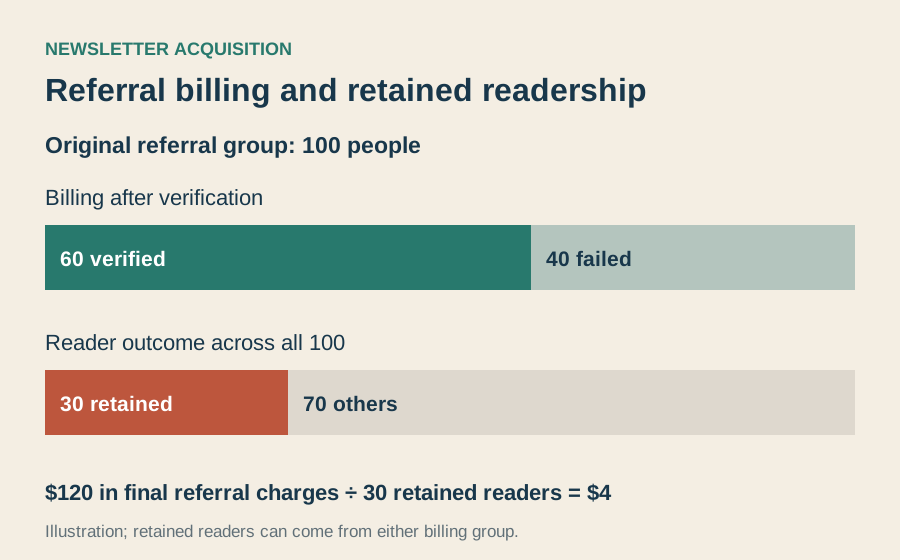
Measure retained readers across the whole referral group
Start with 100 illustrative referrals: 20 pending, 60 verified and 20 failed. At an assumed $2 per verified referral, charges so far are $120. That is an interim billing snapshot: the pending referrals can still change the cost.
Now assume all 20 pending referrals finish as failed, leaving 60 verified and 40 failed. Follow every person in the original 100 for the same 30 days. Suppose 30 remain subscribed and meet a stated readership criterion, such as clicking through to an article during that window. Count qualifying readers from both verification groups. The example’s final referral charges per retained reader are $120 ÷ 30 = $4.
The 30-day window and click criterion are illustrative choices, not beehiiv’s verification rules or a universal definition of retention. Choose the behavior that matches your publication’s purpose and keep it consistent across partners.
| Measure | Illustrative result |
|---|---|
| Original referral group | 100 people |
| Final billing status in this example | 60 verified; 40 failed; none pending |
| Final charges at assumed $2 per verified referral | $120 |
| Retained readers across all 100 after equal follow-up | 30 |
| Referral charges per retained reader | $4 |
Keep billing decisions out of automatic deletion rules
Update pending referrals within their original acquisition group instead of counting them again as new acquisitions. Compare partners only after similar verification time and reader follow-up; unresolved charges can make a new group look artificially cheap.
Check whether a separate removal automation affects failed referrals in your account. Billing verification alone does not establish whether a person unsubscribed or became a useful reader. Keep billing status, subscription status and reader behavior in separate columns.
Reconcile an invoice without losing the cohort
Keep the submitted referral, its billing result and its later readership status in separate columns. If an invoice changes after the initial report, update the billing field while retaining the original signup date. That lets you compare costs and readership on the same cohort rather than shifting people into a later month when their status changes.
Before comparing two partners, give readers from each the same number of days to demonstrate the behavior you care about. A newer partner can look cheaper when billing is incomplete or worse when readers have had less time to engage. Record unknowns separately and wait for a comparable observation window before changing spend.
Calculate acquisition cost after the billing window closes
Suppose a campaign submits 100 referrals, 60 are billed at $2 each, and 30 of the original 100 are still reading after equal follow-up. The resulting $4 per retained reader is only meaningful if the charges and the 30 readers refer to the same starting group. If another ten referrals are billed later, update the cost to $140 without moving the readers into a different cohort. The cost per retained reader becomes about $4.67 if the retained count is unchanged.
Show the billing window and readership window next to the two numbers. That makes it clear whether a later invoice changed the economics or whether readers actually behaved differently. The follow-up decision may be to wait for settlement before reallocating spend.
Calculate what you paid per reader still present at the cutoff. Cost per retained newsletter referral calculator
Share this article
Editorial notes & history
Source verification dates are recorded in the source registry. Sources were checked November 1–2, 2026. Original frameworks are editorial analysis; numerical examples are labeled. Shaun reviewed the preceding edition. This substantive revision awaits his review.
November 1, 2026: initial draft (v0.1.0); shorter title, reading layout and original visual added (v0.2.0); literal headlines, concrete procedures and reconciled examples (v0.3.0). November 2: substantive worked analysis and publisher-usefulness review (v0.4.0); writing SOP and attribution records (v0.5.0); full-body persona critiques and corrected reasoning (v0.6.0).