Jump to a section
Compare the versions before restoring missing text
When an edit removes a useful section, restoring an older WordPress revision may recover it and also bring back an error you already corrected. Compare the versions before choosing a full restore.
WordPress is software for managing website content. Its revisions preserve saved versions and show differences between them. That history helps recover text; it does not establish which version is factually correct. Keep the correction history beside the version comparison. (WordPress revisions documentation ↗)

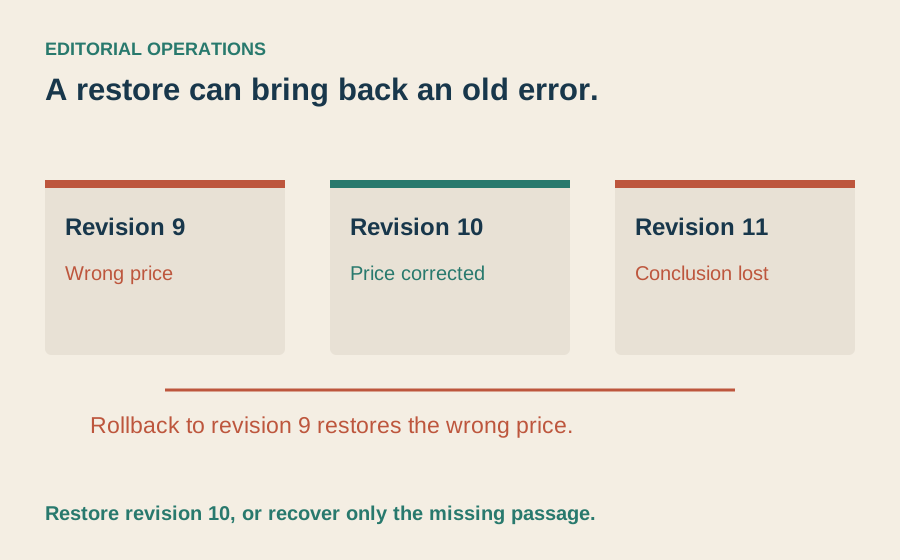
Restoring an old version can restore an old error
Suppose revision 10 fixes an incorrect price. Revision 11 accidentally deletes the conclusion. Restoring revision 9 would recover the conclusion and reintroduce the wrong price. The fastest-looking recovery would undo a valid correction.
In this example, revision 10 already has the corrected price and the conclusion. Restore that complete version if revision 11 contains no other changes you want to keep. If it does, recover only the missing conclusion and preserve those later edits. The right choice depends on the differences, not on a rule that full restores are always wrong.
| Event | Record |
|---|---|
| Price corrected | Old value, corrected value and supporting source. |
| Conclusion restored | Which passage was recovered and from which revision. |
| Final review | Exact resulting revision and actual review outcome. |
A version comparison answers “what changed”; the note answers “why”
Keep the source URL and checked date with the claim, not just a note saying “updated.” If a reader-facing correction is warranted, state the error and repair plainly.
Review the exact resulting revision. An approval attached to revision 10 does not automatically approve revision 12, even if the later edit was intended as a harmless restoration.
After either route, preview the resulting article and check the price and recovered conclusion against the intended version. Record which revision or passage you restored and why. The correction note explains the decision that the version comparison alone cannot supply.
Restore a passage without losing newer edits
Open the current draft and the version containing the missing text side by side. Check whether later edits corrected figures, changed attributions or updated an image caption. If those changes need to survive, recover the missing passage into the current draft rather than restoring the entire older version.
Before publishing, compare the revised draft with the live page and explain the change in the editorial record. If the passage itself includes a source link or a date, check that it still points to the intended evidence. Ask another editor to verify the previously missing text and one of the newer corrections. This catches a restoration that looks complete at first glance but reintroduces a superseded claim.
Keep a preview link for the final check so the second editor can see the rendered text as well as the diff.
Treat a restoration as a proposed edit
Suppose an older revision has the missing paragraph but refers to a $500 figure later corrected to $50. Copying it intact would fix the gap and reopen the error. First recover the useful passage, then compare it against the latest evidence and confirm which figures it refers to. An editor can mark the exact passage that changed and why.
After the change, inspect the live article and any related chart or quote that depends on the figure. Keep the restored draft and the prior public copy available for comparison. If the restoration itself introduces a problem, recover the immediately prior version rather than undoing every change back to the old draft.
Share this article
Editorial notes & history
Source verification dates are recorded in the source registry. Sources were checked November 1–2, 2026. Original frameworks are editorial analysis; numerical examples are labeled. Shaun reviewed the preceding edition. This substantive revision awaits his review.
November 1, 2026: initial draft (v0.1.0); shorter title, reading layout and original visual added (v0.2.0); literal headlines, concrete procedures and reconciled examples (v0.3.0). November 2: substantive worked analysis and publisher-usefulness review (v0.4.0); writing SOP and attribution records (v0.5.0); full-body persona critiques and corrected reasoning (v0.6.0).